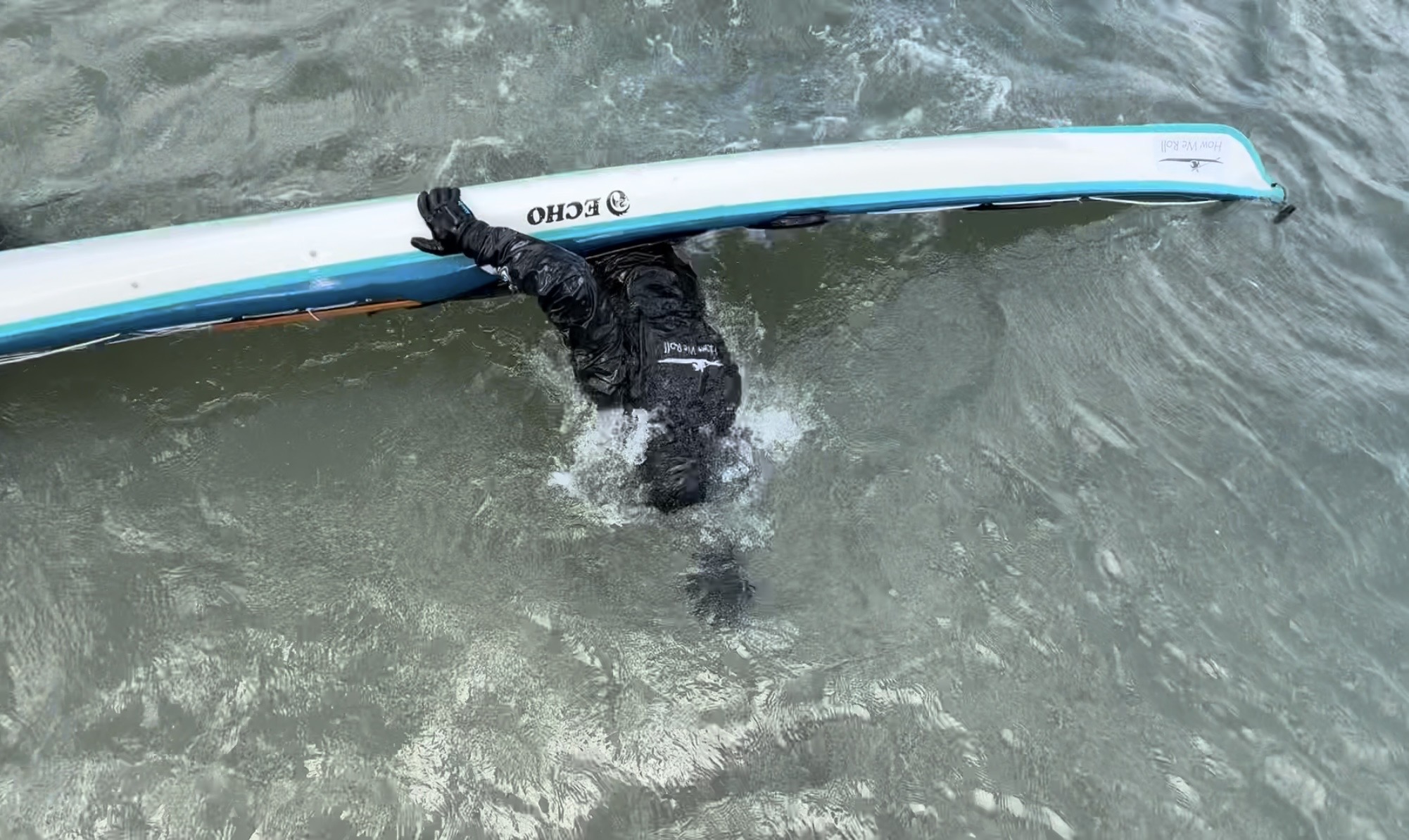
Sometimes we watch someone rolling and the movement looks beautiful. The kayak comes upright effortlessly, the paddler seems completely relaxed, and the whole action appears smooth and graceful.
Other rolls may be technically correct, yet somehow, they lack that same quality. The paddler gets upright, but the movement looks mechanical or forced. Something seems to be missing.
What is interesting is that both paddlers may know exactly the same roll.
The difference is not knowledge alone, but whether the movement has become integrated into one continuous flow rather than remaining a collection of separate actions.
At some point, good rolling looks like a fluent and efficient movement.
Why We Teach Rolling in Steps
If flowing movement is the goal, why do we spend so much time breaking rolls down into individual components?
The answer is simple: complexity.
For an in-depth understanding of any roll, we first need to separate it into manageable pieces. Each component contains enough information to absorb on its own. Trying to understand the entire movement at once would mean important details are missed.
We commonly divide a roll into stages such as:
- Setup
- Hip and leg movement to turn the kayak
- Recovery
And at the beginning this structure is essential for the learning process.
Breaking the roll down helps to:
- Isolate problems
- Simplify learning & create clarity
- Build confidence
Without this process, learning can quickly become overwhelming.
We may, however, become trapped in the individual parts and never reconnect them into a whole.
From Pieces to Patterns
As we gain experience, something interesting begins to happen.
The individual components of the roll start to merge together. What was once a series of separate actions gradually becomes a single movement pattern.
At first, a paddler may consciously think about every stage:
“Set up.”
“Tuck.”
“Sweep.”
“Hip & legs.”
“Recover.”
Or as we like to say: “Nose, hands, hips, head”.
Each part requires some attention and mental effort.
With repetition, however, the brain starts grouping these individual actions together. Instead of processing every movement separately, it begins to recognise larger patterns.
The roll becomes less like following a checklist and more like performing a familiar movement.
Most of us have experienced this process elsewhere. When learning to drive, every action initially requires conscious thought. Steering, changing gear, checking mirrors and observing traffic can feel overwhelming. With experience, these separate tasks blend into a coordinated whole.
Rolling follows a similar progression.
The individual pieces remain important, but they become connected into something larger. The paddler no longer thinks about every component individually. Instead, they experience the roll as a continuous movement with a beginning, middle and end.
This integration is an important stage of learning. If we remain focused only on the individual pieces, the roll can become fragmented and mechanical. However, if we move too quickly towards flow without understanding the fundamentals, important weaknesses can remain hidden. Luckily we still have the water to let us know if we got something wrong.
Therefore, good learning often involves moving back and forth between the two. We separate the movement to understand it, then reconnect it to make it fluid.
The goal is not to forget the pieces.
The goal is to allow the pieces to become one movement.
When Thinking Too Much Interrupts the Movement
Many coaches will recognise a familiar situation.
A paddler performs a roll. It works beautifully. You provide some feedback to help them improve.
They immediately try again and the roll looks worse. The Storm Roll is often a good example of this. At first this seems counterintuitive. Surely more information should create a better result?
What has often happened is that the paddler has shifted from moving to thinking. Instead of experiencing the movement as a whole, they begin consciously monitoring individual body parts:
“Keep my head down.”
“Rotate more.”
“Drive with my legs.”
“Extend my arms.”
The flow disappears. The body becomes stiff. Timing changes. The roll loses its rhythm.
As coaches, this can sometimes make us question our approach. However, we need to remember that this stage is often a necessary part of the learning process. Feedback remains essential, but every new instruction temporarily competes with the body’s existing movement patterns.
Many paddlers have experienced another version of this phenomenon. After a long break from rolling, their first roll of the day is often one of their smoothest.
The body often remembers movement more holistically than the analytical mind allows.
Too much conscious intervention can sometimes interfere with coordination rather than improve it. This is also one reason why rolls can fall apart under pressure. The thinking mind starts inserting small interruptions into what should be a continuous sequence of movement.
But that also means that when a few rolls feel really bad and we start to think there is no hope, the next roll could be the most beautiful one. There is always the possibility that we stop trying so hard and simply relax back into the movement.
Continuous Movement and Whole-Body Feeling
While learning through awareness of individual components and focusing on key concepts is absolutely necessary, we eventually need to move beyond that stage.
As skills develop, the focus gradually shifts away from positions and towards movement.
Experienced paddlers rarely think about individual stages of a roll. Instead, they experience the roll as one connected action.
They often describe sensations such as:
- “Reaching out” (layback hand roll)
- “Spreading the butter with the paddle” (layback paddle roll)
- “Rotate the body around the head as a pivot point” (Storm Roll)
Rather than applying force at isolated moments, they feel force transferring continuously through the body, into the kayak, and through the paddle into the water.
Good rolling often feels less like forcing movement and more like guiding movement that already wants to happen.
The kayak rotates and the body follows.
The magic happens when the kayaker works with the movement rather than against it.
From Setups to Movement Pathways
One way of encouraging flow is to change how we think about teaching.
Rather than focusing entirely on positions, we can focus on movement pathways.
For example, instead of discussing the setup position as a static place, we can think about a movement pathway that describes the entire roll.
The question becomes less:
“Where should I be?”
and more:
“How should this movement feel?”
This subtle shift often helps paddlers move beyond memorising positions and towards understanding the continuous nature of the roll itself.
Teaching Flow Rather Than Only Positions
Developing flow often requires different coaching tools.
Imagery can be particularly powerful because it gives the nervous system a complete movement intention rather than a list of instructions.
Examples might include:
- “Paint a line across the water.”
- “Let the kayak rotate underneath you.”
- “Pour yourself onto the back deck.”
These images encourage movement rather than position.
Other useful approaches include:
- Rhythm-based practice
- Sensory awareness
- External focus
- Slowing movements down
- Smooth, fluid repetitions
Often the best learning occurs when paddlers stop trying to force the movement and begin exploring it instead.
Hand Rolls and Body Awareness
We love hand rolls.
They provide a fascinating example of this principle.
When a paddle is removed, many paddlers discover how much they have been relying on mechanical leverage. There is far less opportunity to overpower mistakes.
Without a paddle, unnecessary tension becomes obvious. Timing becomes more important.
Connection to the kayak becomes more important and body position becomes crucial.
Perhaps most importantly, the paddler begins to feel the movement of the kayak itself.
Many people discover during hand roll practice that they can better tune in with the body: they are sensing the rotation of the boat, the pressure of the water, and the sequence of movement throughout their body.
In this way, hand rolling often becomes less about strength and more about awareness.
Flow Beyond Rolling
This progression is not unique to kayaking and appears in almost every skill-based activity.
Musicians learn scales before they play music. Martial artists practise techniques before they spar fluidly. Climbers learn individual movements before moving instinctively across a wall. Dancers learn steps before they perform with expression.
Learning often follows a similar path:
- Conscious control
- Repetition
- Integration
- Fluidity
The goal is to absorb the technique so completely that it no longer needs to dominate conscious thought.
From Technique to Feeling
Technique matters and without good fundamentals there is little foundation for growth. We need the individual components. We need to understand body position, paddle path, timing and connection to the kayak.
But these components are not the destination.
Eventually, the goal is not to think about more parts of the movement. It is to reconnect the movement into a whole again.
The progression is often from analysis to awareness, from control to trust, and from technique to feeling.
The most beautiful rolls are rarely the ones with the most effort.
They are often the ones where body, boat and water begin to move together as one continuous action. Use your imagination and come up with your personal visualisation of the rolls. We find that this can be good fun and often leads to some interesting discoveries.
Comments are closed