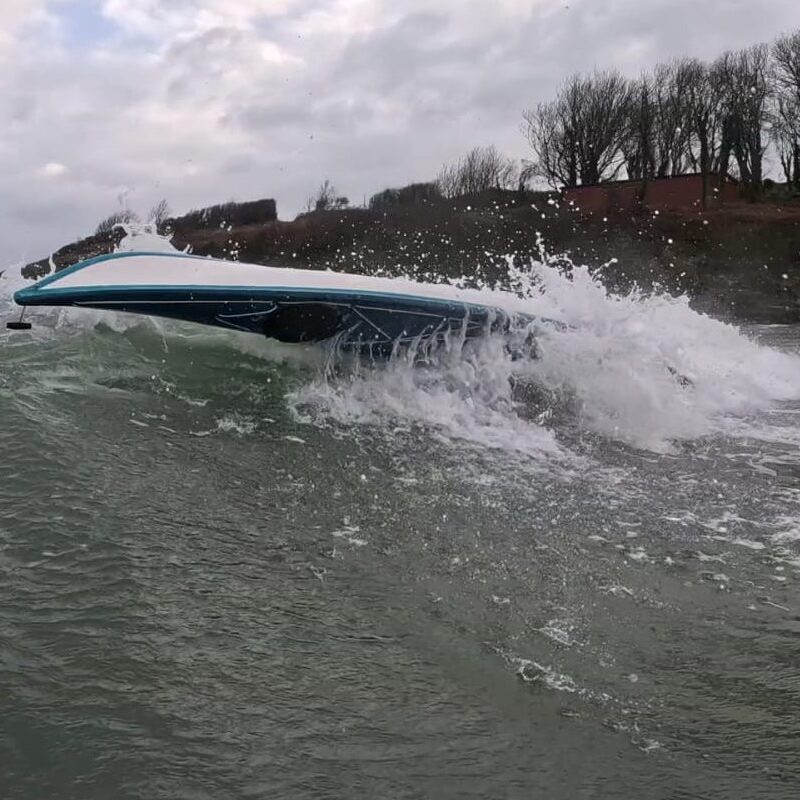
Imagine you’re paddling in the surf. Waves are breaking around you, you’re catching waves, moving in and out of the surf zone and enjoying the energy of the sea.
Then a wave catches you a little harder than expected. Perhaps you decide it’s better to give in than fight it, or perhaps everything happens so quickly that you’re upside down before you know it.
Now the water is in control. But is that necessarily a bad thing?
The wave that knocks you over can also help you roll back up.
A powerful breaking wave continues to push and rotate your kayak. Trying to fight that movement can be exhausting and sometimes completely pointless. But if you allow the water to take you in the direction it wants, you may discover that the easiest recovery is simply to continue the movement the wave has already started.
And this is where rolling becomes really interesting.
From Flowing Rolls to Rolling with the Flow
In a previous blog, we explored how rolling develops from a series of consciously controlled movements into one continuous, flowing action. As the individual components become integrated, we stop thinking about every step and start feeling the movement as a whole.
But what happens when we take that idea beyond flat water?
On flat water, we learn to connect our body and kayak into one fluid movement. In conditions, we can take this a step further and connect that movement with the water around us.
Imagine you can roll on either side, recover on your front or back deck, with an extended paddle or a normal grip. Perhaps you can even recover with only one hand on the paddle or without a paddle.
Suddenly, you have choices.
Instead of fighting your way into the one setup position you know, you can relax, feel what the water is doing and allow your body to respond. A wave may rotate you towards the back deck, or perhaps towards the front. Rather than resisting, you can use that movement to help bring the kayak upright.
This creates an incredible sense of freedom.
Your attention is no longer occupied by remembering the steps of your roll or worrying about whether you’re on the correct side. Instead, you can stay connected to the environment, feeling the movement of the waves and responding to what happens.
Rolling becomes part of how you move with the sea.
Developing the Freedom to Choose
Of course, reaching this point takes time and plenty of practice.
For me, a reliable layback roll and storm roll on both sides provide an excellent foundation. Together, they offer the possibility of recovering forwards or backwards on either side of the kayak.
But you don’t need dozens of different rolls. Even having one reliable roll on both sides can make an enormous difference.
The important thing is to move beyond always practising the same roll from the same setup position.
Try capsizing from different positions. Experiment with different recoveries. Explore how your body and kayak move together, and gradually allow the movements to become more intuitive.
Hand rolls are particularly interesting here. Without the paddle, you become much more aware of the rotation of the kayak and the movement of your body. You learn to feel rather than force the recovery.
Eventually, these skills can be taken into moving water.
Every Environment Has Its Own Rhythm
Surf, tide races, rock gardens and strong winds all present different challenges.
A powerful surf wave may continue pushing your kayak for several seconds. Rather than trying to overpower it, you may be able to use that energy to assist your roll.
In a tide race, the situation can be quite different. Shorter breaking waves, turbulent water and changing currents can create brief, unpredictable forces. Sometimes an immediate roll works beautifully; at other times, allowing a wave to pass before recovering may be easier.
There isn’t one perfect response for every situation.
And that’s precisely why having different rolling options is so valuable.
Of course, practising in conditions requires good judgement. Choose a safe environment, build up gradually and practise with experienced paddlers who can support you. In powerful tidal races, surf close to obstacles or other hazardous situations, avoiding a capsize may be far more important than testing your rolling skills.
When Rolling Becomes Part of Paddling
Perhaps the biggest change is psychological.
Initially, capsizing can trigger an immediate urge to regain control. We tense up, search for our familiar setup position and try to perform the roll we’ve learned.
But with experience and trust in our skills, something changes.
We become more comfortable with the unexpected. We don’t need every capsize to happen in exactly the same way. We can allow the kayak to move, feel what the water is doing and respond naturally.
This doesn’t mean surrendering control or assuming that every wave will help us. It means developing enough awareness and flexibility to work with the water whenever possible.
In our previous blog, we suggested that the most beautiful rolls happen when body, boat and water move together as one continuous action.
Rolling in conditions takes that idea into a new dimension.
The sea is no longer simply the environment in which we perform our roll. Its movement becomes part of the roll itself.
And for me, that’s when rolling really comes alive.
Comments are closed