You want to learn to roll? Maybe you’ve been inspired by watching others make it look effortless, or perhaps you’ve found yourself upside down wishing that a reliable roll would have made the situation a lot less stressful.
Learning to roll can be an exciting journey. It’s a chance to discover new skills, improve your technique, and build confidence in your kayak. At the same time, it can feel intimidating. So where should you start, and how can you make it an exciting challenge rather than a daunting one?
Before beginning, it’s helpful to have some basic kayaking experience. You should feel comfortable sitting in your kayak and being on the water. It’s also worth understanding why you want to learn to roll. Having a clear purpose can provide motivation when progress feels slow.
Getting Comfortable Underwater
One of the first steps is becoming comfortable upside down in your kayak. Practising wet exits is a great place to start. Rather than rushing to escape, learn to slow everything down, stay calm, and become familiar with being underwater.
A snorkelling mask can be a game changer during practice. Being able to see underwater often reduces anxiety and allows you to focus on what is happening. This should always be practised in a safe environment, with someone nearby who can help if needed.
Learning With Support
Discovery and experimentation are valuable parts of learning, but support can make a huge difference. A dedicated rolling course can help you develop good habits from the beginning, avoid common mistakes, and progress more efficiently.
An experienced coach can also provide reassurance when things don’t go to plan, helping to turn frustration into learning opportunities.
Your First Roll
For most paddlers, the first roll to learn is the Standard Greenland roll. While the name may not sound as exciting as the Storm Roll or some of the more advanced Greenland techniques, it is an incredibly powerful and versatile skill.
When learned properly, it can recover you from a wide range of capsizes and provides the foundation for exploring the wider world of Greenland rolling.
Building the Foundations
Rolling is a progressive skill. The fundamentals are what support everything that comes later.
These include:
- Developing a strong connection with the kayak.
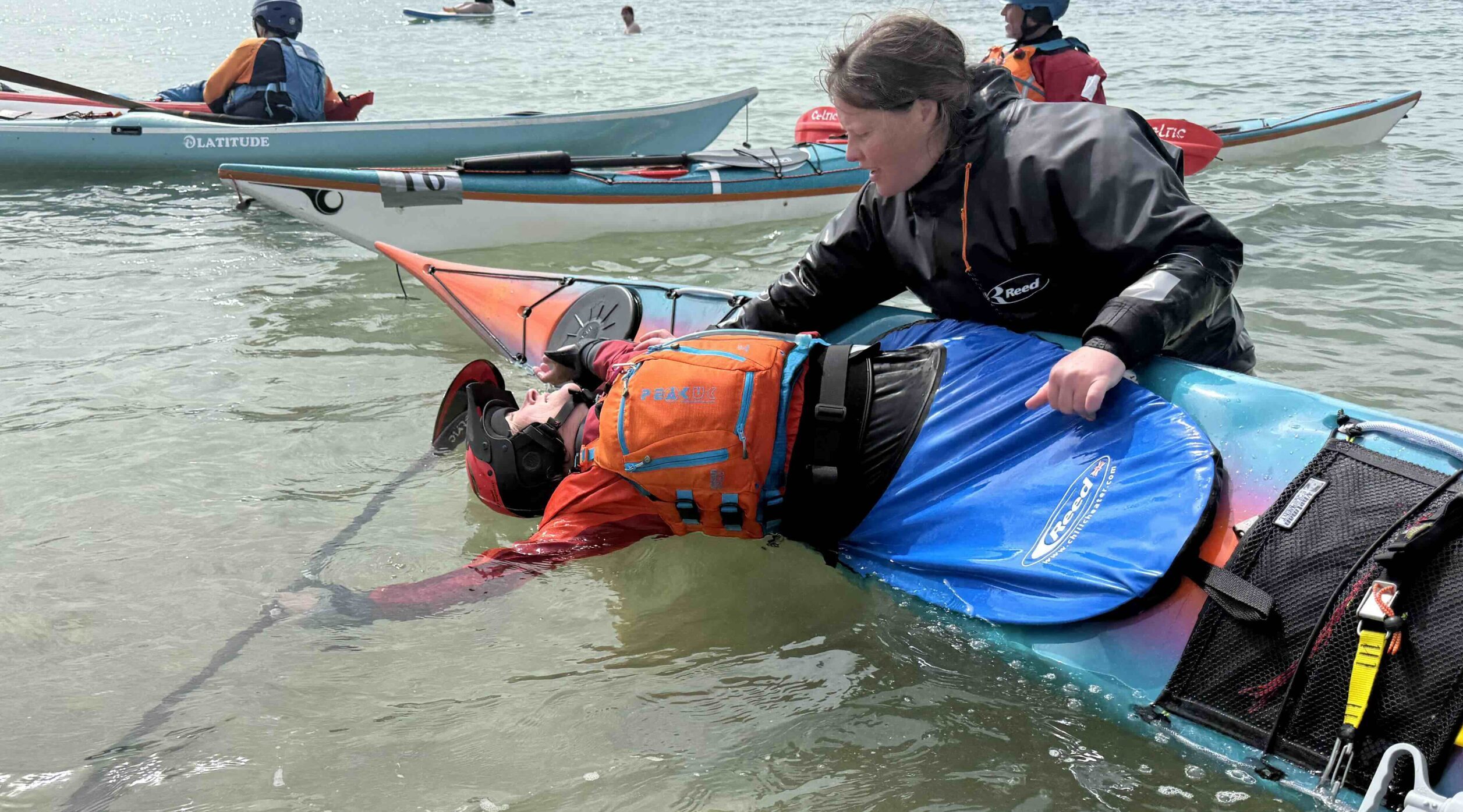
- Learning to rotate your upper body so that you can find support and flotation on the water’s surface (such as in the Balance Brace).
- Understanding how your legs and hips work together to either drive the kayak upright or pull your body to the surface at the initiation of the roll.
- Developing good timing and coordination. This mean understanding the sequence of movements that will lead to success.
- Learning how blade angle affects support and lift during the roll. This is best learned by feeling the benefit nice sweep across the surface rather than having a diving blade.
Many beginners focus on getting their head out of the water as quickly as possible. Successful rolling often comes from trusting the sequence of movements, staying relaxed, and allowing the kayak to come upright first before recovering the body on the back deck.
Relearning your natural response
One of the biggest challenges when learning to roll isn’t mastering a new movement: it’s relearning some of our instinctive responses to being upside down in the water. Our natural reaction is often to try to lift our body towards the surface as quickly as possible. In a kayak, this usually has the opposite effect to what we aim for. Lifting the body too early causes the paddler to pull with the wrong leg (the upper leg) on the kayak, dropping the kayak on top of them and making the roll impossible or at least much harder than it needs to be.
These instinctive reactions can quickly become habits if they aren’t recognised early, which is why many paddlers struggle despite putting in lots of practice. Good coaching helps identify and replace these habits from the start, allowing you to develop movements that work with the kayak rather than against it, making the whole learning journey smoother, more enjoyable, and ultimately more successful.
If your roll feels heavy, check that you don’t engage your top leg in the recovery: drop it into the centre of the kayak and see what difference it makes.
Enjoy the Process
One of the most rewarding aspects of learning to roll is that there is always something new to discover. Every practice session teaches you something, whether it’s a small improvement in technique, a better understanding of body position, or simply becoming more comfortable underwater.
Don’t worry if progress isn’t immediate. Rolling is a skill that develops through repetition, patience, and understanding. Celebrate the small victories along the way and remember that every successful roller once spent time upside down wondering how everyone else made it look so easy.
The journey is part of the fun.
Comments are closed